Skip to content
← Back to Nexus
Русский

ARBA Nexus

Nexus mark

Nexus Enterprise AI

One AI across the whole company: its data, documents, projects and rules

  • ARBA International B.V.
  • Delivery — Telecon and Impace Group
ARBA Nexus

ARBA Nexus

What we mean by enterprise AI

Nexus is one place where an employee states a task in plain words and the system carries it out on the company’s data, its documents, its projects and its rules. One way in, instead of a shelf of assistants that each know one corner of the business.

It reads the systems you already run, puts the data in order where the task requires it, and works on top of them — with the authority of the person who started it, evidence under every conclusion, and a human decision wherever something material changes.

One set of permissions, one audit log, one body of evidence — across the whole company

ARBA Nexus

Boundaries

Where the product’s boundaries run

In an enterprise conversation this is the first question: what are we buying, and what are we not throwing away

What Nexus is

  • A place where enterprise AI scenarios actually execute
  • Managed data planes of its own: master data, documents, projects
  • One layer for authority, evidence, checkpoints and cost accounting

What it is not

  • Not a replacement for your ERP, your document management, Microsoft 365 or your project systems
  • Not a chatbot that answers beside the process and owns none of it
  • Not a black box that first demands perfect data

Nexus reads the estate you already have, puts data in order where the scenario needs it, and runs the work on top

ARBA Nexus

Differences

How this differs from what you have already tried

Each of these approaches does part of the job, and each can be extended with integrations. The question is where it stops in a standard deployment

ApproachWhere it stopsWhat Nexus does
Office-suite assistantOut of the box it knows one person’s mail and files, not your master data or your rulesRuns on governed company data and acts in your systems — within that person’s authority
Document searchWithout further integration it returns a quote and stops there: no task, no ownerThe answer is a step of a task, with an owner, a checkpoint, a trace and a cost
Master-data programmeA separate project on a long horizon: one budget pays, another function sees the resultOrder is created inside the work itself and pays for itself on the first domain
Bespoke developmentIn a typical point solution every further process is a new project, a new stack and a new contractYour own people describe the scenario; the library of capabilities grows on your side
ARBA Nexus

Mechanics

How one answer destroys trust in the whole technology

Automation amplifies what is already there. A language model will not warn you that the data contradicts itself — it will produce a fluent, confident and wrong answer

  1. The data contradicts itselfThree records for one counterparty, mixed units, dead codes still in use
  2. The model answers confidentlyFluent text, precise figures, no hedging
  3. The figure enters a decisionIt is shown to the board
  4. The error surfacesIn public, during review
  5. The subject is closedTrust is lost not in the data quality but in artificial intelligence as such

There is nothing left to defend the next initiative with — and that costs more than the error itself

ARBA Nexus

The price

Bad data costs money long before any AI

AI creates none of this — it only makes the consequences visible and fast

  • $12.9Maverage annual loss per organisation from poor data quality4
  • 63%of organisations either do not have AI-ready data management practices or are not sure they do3
ARBA Nexus

The answer

Putting data in order is the first job, not the entry ticket

Most AI products open with a condition: get your data in order and then we will talk. Nexus is built the other way round — creating that order is the first piece of work it takes on.

The intelligence sits on the hardest part rather than on the surface: matching records, resolving duplicates, normalising descriptions, discovering rules and testing quality. Nobody works through thousands of rows by hand — people decide on prepared candidates that come with evidence.

The first bounded domain is scoped to go live in weeks

ARBA Nexus

Honest about maturity

Where the product stands today

Three live installations at different stages of industrial use: at a customer — a major copper producer in Central Asia, at a delivery partner in Kazakhstan, and at ARBA itself, where the vendor runs its own processes

  1. Running on real data

    • Master data — golden records from the customer’s ERP: counterparties and units of measure
    • Document store — a corporate corpus with recognition, cited search, retention schedules and legal holds
    • Project control — the owner’s assurance picture over contractors’ documents on a capital project
  2. Rolling out now

    • Master data at full domain scale — validation continues
    • Service desk — a pilot for named groups in Microsoft Teams with governed status write-back
  3. Next stage

    • Service desk beyond the pilot groups
    • Further master-data domains on the same foundation, without rebuilding it

As of 3 August 2026. Writing into ERP and finance systems stays behind a human decision — by design, not by technical limitation. Which capabilities are switched on is decided per installation

ARBA Nexus

Execution spine

Every task travels the same path

  1. RequestFrom chat, a channel or a ticket
  2. TaskA tracked object, not a one-off answer
  3. AuthorityThe agent acts for whoever started it; rights are checked at every step
  4. ToolsA reasoning loop inside a permitted toolset
  5. CheckpointMaterial records wait for a human decision
  6. TraceEvery step recorded, every cost counted

The same path for a procurement scenario, a master-data cleanup and a service request — governance is not bolted on top, it is built into execution

ARBA Nexus

Platform

One foundation, four components

Core

  • Scenarios — processes the AI carries out by reasoning, not by a rigid script
  • Tools and connectors — the platform’s governed hands
  • One execution spine: authority, evidence, checkpoints, tracing, cost accounting

Data planes of its own

  • Master data — golden records, quality, hierarchies
  • Document store — recognition, classification, cited search, retention
  • Project control — an assurance picture across projects, on top of your systems

Your estate

  • SAP · Oracle · 1C · Microsoft · Primavera · in-house systems
  • Read as sources, governed on top, never replaced

The components run on one core: access, logging, evidence and cost accounting are configured once, not again for every task

ARBA Nexus

Level 1

A master-data domain in disarray

An illustrative master-data scenario: the same engineer’s request, the same company, the same people and systems. The only difference from the next frame is the maturity of the domain

  1. An engineer needs a bearing for a stopped assembly
  2. Three similar records, none an exact match: different descriptions, old supplier codes, different units
  3. Easier to create a new item than to prove the old one is the same thing
  4. Ordered with a margin: lead times are long and nobody wants to repeat the cycle
  5. Months later the item reaches the warehouse
  6. Some goes into the job, the rest settles on a shelf. The same bearing is already in stock at the neighbouring site — but it cannot be found

And round again, at every site

Cash is frozen in warehouses, procurement is loaded with repeat cycles, and the stock still is not where it is needed

ARBA Nexus

Level 2

The same domain, assembled

  1. The same engineer, the same assembly
  2. One record: synonyms, old supplier codes and other sites’ designations all resolve to it
  3. Stock at the neighbouring site and open requisitions for the item are visible at once
  4. An internal transfer instead of a purchase — the assembly restarts within days
  5. The issue is booked, the minimum-stock rule fires, procurement automatically receives a replenishment request
  6. No new item is created: the system will not accept a duplicate without review and an owner’s decision

The same process, the same people, the same systems. Only the state of the master-data domain changed

A domain is not one reference list: a material lives together with its classification, units of measure, manufacturers and supplier codes. The unit of work is the whole domain — a material list cleaned on its own changes nothing

ARBA Nexus

Interface

The conversational console

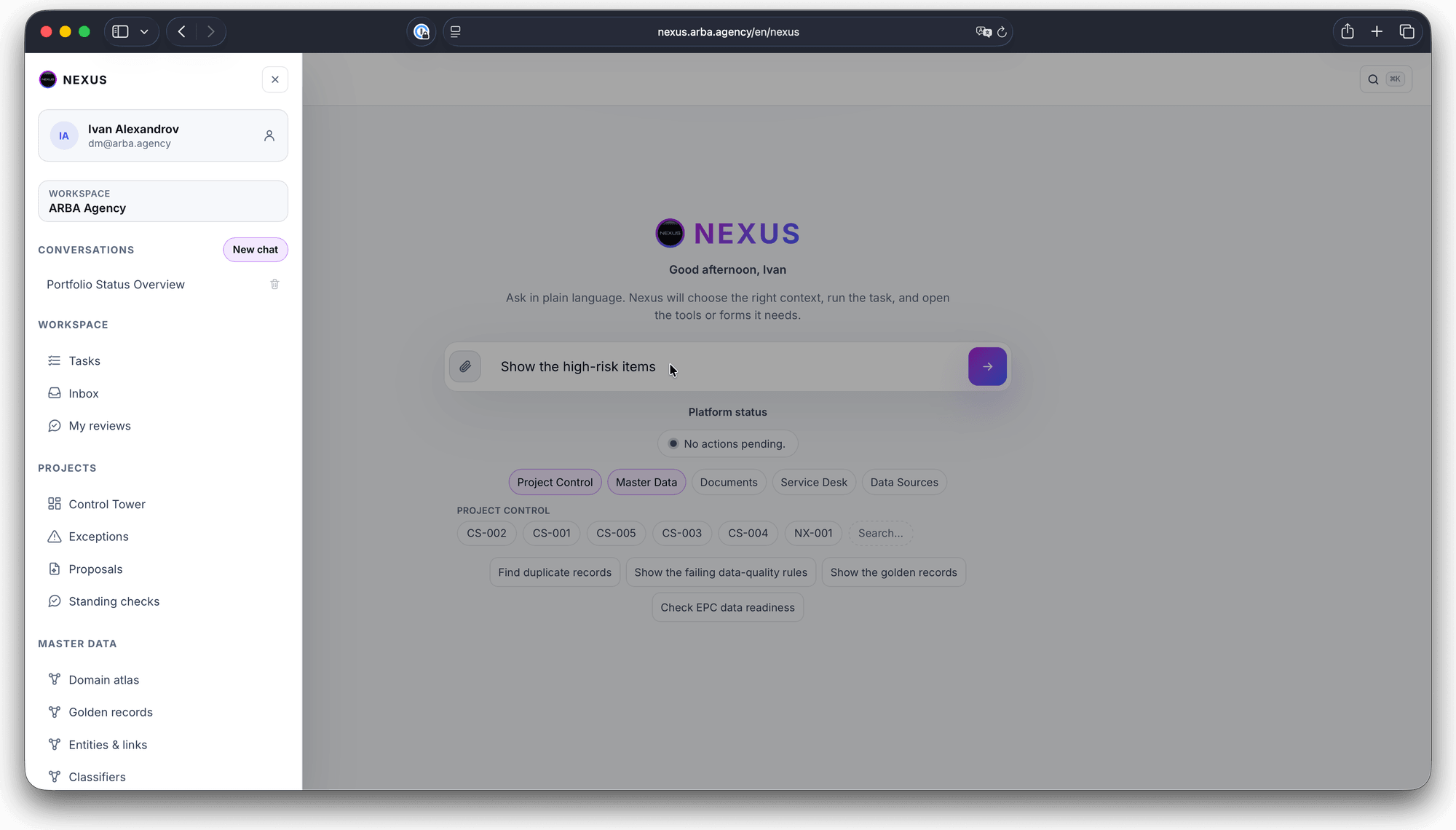
The Nexus conversational consolescreen to be added
The agent’s work in the open: sources, tools called, evidence and human decisions

What the screen shows

  1. 1The task plan and the steps already taken
  2. 2Sources and tools used
  3. 3The checkpoint and the human decision
  4. 4The trace and the cost incurred
ARBA Nexus

Trust

What makes such an AI fit for industrial operation

  • Evidence

    Every fact carries a link to a document, a record and a version. «Not enough data» is a complete answer, not a failure

  • Full trace

    Who asked, which sources and tools were used, what the human decided. The work can be replayed

  • Human confirmation

    A material change passes a checkpoint: the work stops and waits for an authorised decision

  • On the user’s behalf

    Nexus checks the starter’s authority before reading data and before any action — the agent holds no rights of its own

  • Sovereignty

    The data plane stays inside your perimeter, up to full isolation from external networks

  • Your model

    Inference goes through your endpoints; the egress latch rejects calls to addresses outside the allow-list

ARBA Nexus

Economics

AI whose running cost is visible and can be capped

  • Every call is counted

    Cost is attached to a task, a scenario and a person — you see what a specific process costs, not «AI» in general

  • A ceiling as a fuse

    A daily spend limit stops the work before the bill becomes an unpleasant surprise

  • The model fits the job

    Different tasks route to different models: some need the strongest, some are fine on a fast and cheap one

ARBA Nexus

First stage

Test the machinery on one uncomfortable domain

Not a year-long programme but a bounded test on real data — with the decision agreed in advance

  1. From you

    Input

    • An extract of the chosen domain
    • A data owner and subject-matter experts
    • Quality criteria and constraints
    • An agreed perimeter
  2. Together

    Process

    • Profiling
    • Candidates with evidence
    • Decisions by your specialists
    • Rules and trace recorded
  3. Output

    Result

    • A measured picture of quality
    • A reviewed set of candidates
    • Golden records and rules
    • Architectural conclusions for scale

The stage ends in a joint decision: continue, adjust or stop. Scope, criteria and calendar are fixed once we have seen the data

ARBA Nexus

Who does what

Where responsibility sits

A baseline for discussion: exact boundaries and the partner line-up are fixed per project

  • Product

    ARBA Agency

    ARBA Agency mark
    • Core architecture and development
    • Releases and product support
    • Methodology for scenarios and data planes
  • Delivery

    Telecon and Impace Group

    Telecon logoImpace Group logo
    • Local delivery and project management
    • Integrations and environment preparation
    • Training and change support
  • Ownership

    Customer

    • Domain owner and success criteria
    • Access, policies and perimeter decisions
    • Approval of material changes

Responsibility for a material change to data stays with the customer in every configuration

ARBA Nexus

Next step

Start with one domain

There is no need to start with a year-long programme. Take the single most painful domain — materials together with their classification, units of measure and supplier codes, for example — and watch the machinery work on it: extract, profiling, candidates with evidence, decisions by your specialists, a golden record.

The domain is taken whole not out of perfectionism: the effect comes from the links, not from one cleaned record. From there the same foundation carries the next domains, documents, projects and scenarios — with no second build.

Discuss a review of your master-data domain
ARBA Nexus

On request

Appendix

The material usually needed after the meeting rather than during it: the evidence base, the mechanics and the depth of each plane

  • The market and the research: three figures from 2026 and two field experiments
  • Master data in depth: from extract to golden record and beyond the first cleanup
  • The platform’s planes: documents, records management, project control
  • The research core and the effect of every new connector
  • Operation inside your perimeter, and the source list
ARBA Nexus

Where the market stands

Three figures that describe 2026

One observation across a sample of public deployments and two Gartner forecasts. None of the three is about model quality

  • 95%of generative-AI pilots in a sample of public deployments produced no measurable effect on financial results1
  • 40%+of agentic-AI projects will be cancelled by the end of 2027 — Gartner’s forecast: cost, unclear value, inadequate risk control2
  • 60%of AI projects unsupported by AI-ready data will be abandoned by the end of 2026 — Gartner’s forecast3
ARBA Nexus

The trap

How companies arrive at those figures

  • AI for its own sake

    A solution is chosen because it has artificial intelligence in it, not because of the job it closes

  • Sprawl

    Every pilot brings its own infrastructure, its own access model, its own log and its own contract. The estate grows faster than the benefit

  • One pilot, one task

    A narrow context: the tool knows nothing about the neighbouring process and does not remember yesterday’s conversation

  • Stopping at the edge of production

    The demo passes. The test against real data, real rights and real risk does not

ARBA Nexus

Diagnosis

The divide does not run along the models

The MIT NANDA study examined 300 public deployments, executive surveys and a series of interviews — and found no link between success and the choice of model. What separates the successful 5% is different: they embed AI in a real working process, give it memory and company context, and carry it through to production.

The rest buy a general-purpose tool that is convincing in a demo and helpless in the flow of work.

The question is not which model, but what it stands on

ARBA Nexus

And yet

Opting out of AI is not an option

The need is real. AI is becoming the difference between a company that decides in hours and a company that spends weeks assembling the data for that decision.

So the question is not whether to adopt AI but what to build it on — because the foundation is what decides whether adoption reaches production.

ARBA Nexus

Two field experiments

How AI changes work: two measured cases

Two field experiments: different tools, different tasks, different metrics

An assistant trained on company data

A purpose-built support assistant trained on the history of customer conversations · 5,172 agents, The Quarterly Journal of Economics, 2025

  • Issues resolved per hour, on average+15%
  • Among less experienced agents+30%
  • Fine-tuned on customer conversations weighted by outcome — that is, on the practice of the best agents — and it surfaces links into internal documentation
  • Those practices transfer to less experienced staff and lift them towards the average; for the most experienced the gain is speed alone, and quality dips slightly

A general model in an expert’s hands

General-purpose GPT-4 on realistic consulting tasks · 758 BCG consultants, 18 assignments, Harvard Business School

  • Tasks completed+12.2%
  • Time per task−25.1%
  • Assessed quality of output+40%
  • That is inside the model’s frontier. Beyond it the same consultants were 19 pp less likely to reach the correct solution

The two studies cannot be compared directly by effect size. Together they show that the result depends on the task, the data, the model’s frontier and the human’s role

The metrics differ between the studies and the bars are normalised within each column: the columns are compared by meaning, not by height

ARBA Nexus

The condition

What augmenting an expert is made of

Remove any one term and augmentation becomes the accelerated production of confident errors

Company context+Evidence under every answer+Human confirmation

The expert works faster and stays right

ARBA Nexus

The root

Bad data is a bad foundation for automation

Automation amplifies what is already there. If reference lists disagree and one counterparty lives in three systems under three names, automation will amplify exactly that.

And a language model will not flag the contradiction. It will produce a fluent, confident, wrong answer.

ARBA Nexus

Why it still is not done

The classical route to governed data costs too much

An enterprise master-data programme is a project in its own right: its own team, its own catalogue, its own standards and a long horizon. The result is visible to someone other than the budget holder, and not soon.

So it is deferred, again and again. Order in data is needed by everyone at once and by no one in particular — no single function will fund it whole and wait longer than its own planning horizon.

A data foundation everyone needs and nobody builds

ARBA Nexus

How it works

From extract to golden record

  1. 1SourceAn ERP extract or a customer file is fixed as an immutable source version — you can return to it and repeat everything
  2. 2ProfilingNexus shows what is actually in the data: completeness, formats, anomalies, disagreements in units of measure
  3. 3RulesIt proposes normalisation and matching rules that account for legal forms, Cyrillic and Latin script and legacy codes — and tests them against history
  4. 4CandidatesIt assembles duplicate pairs and groups with an explanation: which attributes matched, which diverged, what is missing
  5. 5Human decisionThe owner confirms or rejects. The AI proposes; the person disposes
  6. 6Golden recordThe surviving record is assembled: you can see which value won each field and why. The merge is reversible
  7. 7PublicationGoverned distribution of the golden record to consuming systems. Writing back into the source stays behind a human decision
ARBA Nexus

Master data in depth

A domain lives on past the first cleanup

A one-off cleanup degrades within months. So the platform carries what holds quality continuously

  • Quality under observation

    Rule-based profiling, statistical anomaly detection, validation against classifiers and normalisation proposals — as an explained queue of work, not as silent edits

  • Hierarchies and reorganisations

    Groups, nodes and roll-ups across a tree; moving a node does not erase history, it opens a new period of validity

  • Memory over time

    Bitemporality: «how it actually was» and «how we knew it» are kept apart. Correcting an error does not rewrite the past, it records new knowledge

  • Publication and divergence

    The golden record goes to consumers as a governed package; a separate view shows where master and source have drifted apart

ARBA Nexus

Interface

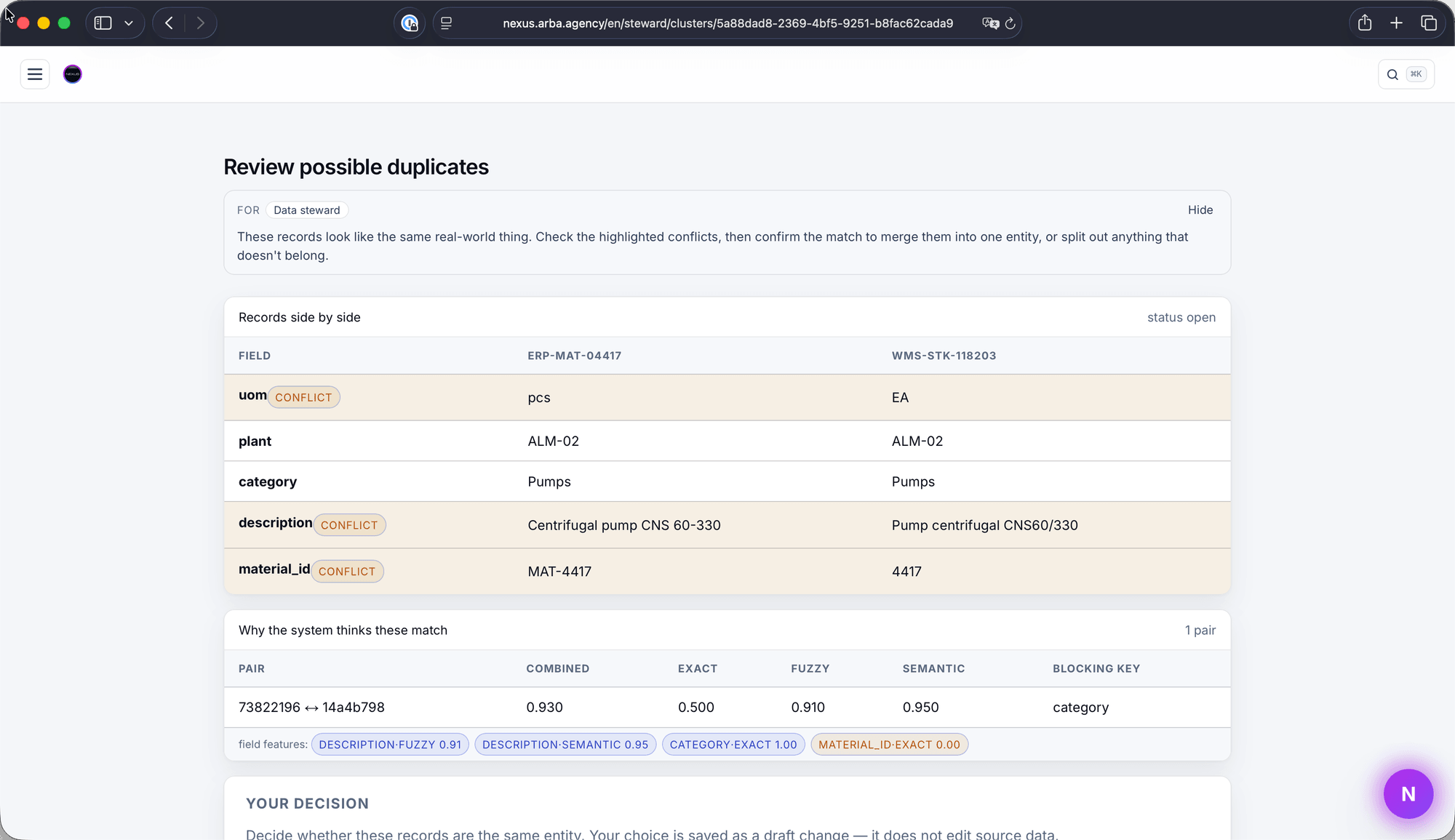
Resolving duplicates

The Nexus merge-candidate review screenscreen to be added
Candidates with an explanation: which attributes matched, which diverged, what is missing

What the screen shows

  1. 1The source records and their systems of origin
  2. 2Attributes that matched and diverged
  3. 3The reasoning behind the recommendation
  4. 4The data owner’s decision
ARBA Nexus

Research core

What separates the core from an «AI construction kit»

Nexus is not a wrapper around someone else’s model or an assembly of off-the-shelf blocks. Underneath are ARBA’s own research results, shared by every component of the platform

  • Global context

    The system holds a picture of the whole corporate corpus rather than the window of one document: an answer rests on the links between sources

  • Parallel execution

    A complex task is decomposed and run in parallel by several agents, then reconciled

  • Knowledge on a live graph

    Knowledge is attached to a model of the organisation — entities, roles, ownership, hierarchy — not to flat folders

  • Adversarial verification

    A result passes self-checking and counter-verification before it reaches the user

  • Memory over time

    Bitemporality: the system remembers both how things are and how they were known at any point in the past — an answer is reproducible to a point in time

  • Hybrid methodology

    Deterministic, semantic and probabilistic methods work together — engineering rigour instead of prompt magic

ARBA Nexus

Surfaces

Nexus lives where people already work

  • Conversational console

    One way in: state the task in words, watch the work, the evidence and the decisions

  • Assistant over the screen

    Answers in the context of the page you have open and points at the very field in question

  • Microsoft Teams

    Requests, answers and approvals in the channel people already use, with no separate portal

  • API

    The same capabilities for your own systems — with the same rights checks and the same tracing

ARBA Nexus

Scenarios and Studio

A new capability is described by your employee, not by a contractor

A scenario describes a process: what result is needed, which tools may be used, where a checkpoint is mandatory and whose authority is required. The agent does not follow a rigid script; it reasons inside those bounds.

An employee describes the process in words, Nexus proposes a governed scenario, the owner reviews and activates it. The library of capabilities grows on your side, not ours.

Customers create scenarios; they do not create authority for themselves — that is checked on activation

ARBA Nexus

Global context

Why Nexus knows your company from the first question

  1. Level 1Map of the corpusWhat exists at all: collections, volumes, owners, links
  2. Level 2DigestsA summary of every document and of groups of them, recomputed as things change
  3. Level 3Cross-cutting observationsFindings visible in no single document on its own: contradictions, gaps, changes between revisions
  4. Level 4Standing backgroundAll of the above is mixed into every answer — within the rights of the individual asking

This is not loading every document into the prompt: the map, the digests and the observations go into the work, not the corpus itself

ARBA Nexus

Documents

From a scan to an answer with a citation

  1. IntakeUpload, a folder, SharePoint or mail
  2. RecognitionRussian, Kazakh, English — paper stops being an obstacle
  3. ClassificationDocument type and attributes extracted automatically
  4. LinksThe document attaches to a counterparty, an asset, a project
  5. AnswerA quotation linked to the document and the page

The main reason corporate archives decay is manual attribute entry. Here an agent does it and a person confirms

ARBA Nexus

Records management

What counsel and the auditor will ask for

  • Retention schedules

    Governed rules: a document knows its retention period and the date it starts

  • Legal holds

    A hold outranks retention: while a dispute runs, the document cannot be destroyed

  • eDiscovery

    Selection by the subject of a dispute and a sealed export of the inventory with version and access history

  • Read log

    You can see who opened a document and when — not only who changed it

Separation of duties is mandatory: whoever places a hold does not destroy, and whoever destroys does not place holds

ARBA Nexus

Project control

Reported status against supported status

The project-control plane does not replace your execution systems — it reads them and shows the owner where the report and the evidence have diverged

Reported by the project manager85 %
Supported by documents58 %

The gap is what the plane exists for

Schematic: the ratio is shown for clarity. In the product both figures are computed for a specific project period, and every deviation enters an exception queue with an owner

ARBA Nexus

The effect

Every new connector strengthens every scenario at once

This is where the logic of a zoo of pilots breaks: pilots add up, connectors multiply. Connect the warehouse and procurement, maintenance and project control all see it — not just a «warehouse assistant»

Nexus core6 connectors · 5 scenariosProcurementMaintenanceProject controlBack officeSupport
ERPavailableavailableavailableavailableavailable
Warehouseavailableavailableavailableavailableavailable
Documentsavailableavailableavailableavailableavailable
Mail and Teamsavailableavailableavailableavailableavailable
Projectsavailableavailableavailableavailableavailable
Service requestsavailableavailableavailableavailableavailable

Instead of a set of assistants — one enterprise AI that holds both the operational and the strategic picture

ARBA Nexus

Sovereignty and operation

How this lives inside your perimeter

  • Separate installations

    One product image, separate independent installations: own database, own settings, own tenant account

  • Pull-only updates

    The installation fetches a signed release when it chooses. Nothing is pushed into the perimeter from outside

  • Full isolation from external networks

    Running with no external connections is supported as standard: the platform keeps working from packages already received

  • Release discipline

    A weekly release cycle; a build is not accepted until it passes end-to-end validation against twenty business scenarios

Release cadence and the composition of end-to-end validation as of 3 August 2026

ARBA Nexus

Evidence base

Sources

  1. MIT NANDA. The GenAI Divide: State of AI in Business, 2025About the effect on financial results across a sample of public deployments — not about whether the pilots technically worked.
  2. Gartner. Over 40% of Agentic AI Projects Will Be Canceled by End of 2027, 25.06.2025A forecast, not a measurement. Gartner names the causes itself: escalating costs, unclear value, inadequate risk controls.
  3. Gartner. Lack of AI-Ready Data Puts AI Projects at Risk, 26.02.2025The forecast is conditional: it covers projects not supported by AI-ready data, not AI projects in general.
  4. Gartner. Data Quality — the cost of poor data
  5. Brynjolfsson E., Li D., Raymond L. Generative AI at Work. The Quarterly Journal of Economics, 2025
  6. Dell’Acqua F. et al. Navigating the Jagged Technological Frontier. Harvard Business School / BCG

Every quantitative claim in this deck rests on the public research listed here

ARBA Nexus
ARBA Nexus — enterprise AI on your company’s own data